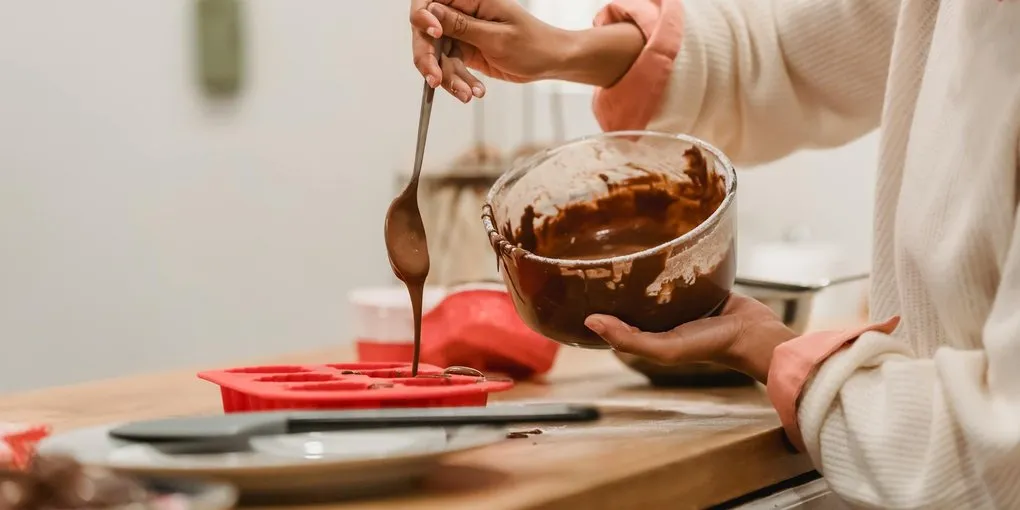
Tempering is the science. Molding is the craft. You can produce perfectly tempered chocolate and still end up with bars that have dull spots, trapped air bubbles, or refuse to release from the mold. The gap between well-tempered chocolate in a bowl and a finished bar with clean gloss and sharp edges is technique — and the technique is surprisingly specific.
Mold Types
Polycarbonate Molds
Polycarbonate is the standard for craft chocolate making. These rigid, transparent molds are what professionals and serious home makers use for bars, bonbons, and specialty shapes.
Advantages:
- Rigid structure produces sharp edges and consistent bar thickness
- Smooth, polished surface creates the best gloss on the finished chocolate — the bar’s surface is a mirror of the mold surface
- Transparent material lets you see the bottom of the chocolate during cooling, which is how you monitor crystallization
- Durable — a well-maintained polycarbonate mold lasts for years
Disadvantages:
- Requires properly tempered chocolate for clean release (this is a feature, not a bug — it is your quality control check)
- More expensive than silicone
- Must be handled carefully — scratches on the mold surface transfer directly to the chocolate surface
Cost: Approximately $10 to $30 for standard bar molds from suppliers like Chocolate World, Martellato, or Tomric. See our mold buying guide for specific recommendations.
Silicone Molds
Silicone molds are flexible, inexpensive, and widely available. They have legitimate uses but also significant limitations.
Advantages:
- Flexible material means chocolate can be physically peeled out — less dependent on perfect temper for release
- Inexpensive and available in thousands of shapes
- Good for confections where perfect gloss is not the priority (bark, clusters, novelty shapes)
Disadvantages:
- The matte surface of silicone produces a matte finish on chocolate — no gloss
- Flexible walls make it difficult to achieve uniform thickness
- Can retain odors from previous uses
- Poorly tempered chocolate will still release, which removes an important quality feedback loop
When to use silicone: For applications where appearance is secondary to speed or where unusual shapes are needed. For serious bar making, polycarbonate is the standard.
Custom Molds
For makers producing bars at scale, custom molds with branded logos, bar scoring lines, and specific dimensions are available from manufacturers like Chocolate World. These are typically polycarbonate and require minimum orders. The investment makes sense once you have a consistent product and a reason to brand it.
Preparing the Mold
A clean mold is the foundation of a good bar. Residue from previous batches, fingerprints, moisture, or dust will all transfer to the chocolate surface.
Cleaning: Wash polycarbonate molds with warm (not hot) soapy water. Rinse thoroughly. Dry completely — any residual moisture will cause sugar bloom or dull spots on the chocolate surface. Air-dry on a clean towel or use a lint-free cloth.
Polishing (optional but recommended): Buff the mold cavities with a clean, dry cotton ball or lint-free cloth. This removes any microscopic residue and ensures maximum gloss transfer. Some makers use food-safe cotton gloves while handling molds to avoid fingerprint oils.
Temperature: The mold should be at room temperature (approximately 20 to 22 degrees Celsius) before filling. A cold mold causes the chocolate to set too quickly on contact, potentially trapping air bubbles and creating poor crystal structure at the surface. A warm mold keeps the chocolate too fluid and slows set time.
Filling Technique
Pour tempered chocolate into the mold cavities. The working temperature for dark chocolate should be 85.5 to 87 degrees Fahrenheit (29.7 to 30.6 degrees Celsius) — never exceeding 90 degrees Fahrenheit. If the chocolate has cooled below working temperature, brief gentle rewarming is acceptable but do not exceed 93 degrees Fahrenheit, at which point you need to add seed chocolate.
Pour in a steady stream into the center of each cavity. Let the chocolate flow outward to the edges rather than trying to pour into corners. This minimizes air entrapment.
Tap the mold firmly on the counter 3 to 5 times immediately after filling. This serves two purposes: it settles the chocolate into corners and details, and it brings air bubbles to the surface where they can escape. The tapping should be firm enough to feel through the counter but not violent enough to splash chocolate out of the cavities.
Vibrate for stubborn air. If you have a vibrating table (even a cheap one designed for concrete forms), 10 to 15 seconds of vibration after filling removes virtually all trapped air. This is the single best investment for improving bar quality after a good thermometer.
Scrape the excess. Use a bench scraper or offset spatula at a 45-degree angle to remove chocolate from the top surface of the mold. This creates clean, flat bar backs. Scrape firmly in one direction, then in the perpendicular direction. Work while the chocolate is still fluid.
Cooling and Contraction
Properly tempered chocolate contracts as it crystallizes. This contraction is what causes the bar to pull away from the mold walls and release cleanly. Understanding this mechanism is key to troubleshooting release problems.
Form V contraction. When cocoa butter crystallizes into Form V, it occupies less volume than the liquid phase. This volume reduction pulls the chocolate inward, creating a gap between the bar and the mold. This is why properly tempered chocolate “pops” out of a polycarbonate mold with minimal effort — the bar is already physically separated from the mold surface.
Cooling rate. Allow chocolate to cool at room temperature (18 to 22 degrees Celsius). Do not accelerate cooling by putting molds in the refrigerator or freezer. Rapid cooling can cause several problems:
- Thermal shock creates internal stress that can crack the bar
- Condensation on the cold mold causes sugar bloom
- Uneven cooling produces uneven crystal formation and dull spots
Cooling time. Standard bar molds at room temperature: 20 to 30 minutes for a 50 to 80 gram bar. Thicker bars or bonbon shells need longer. The chocolate is set when the bottom of the mold (visible through polycarbonate) shows uniform opacity and the edges have pulled slightly away from the mold walls.
Temperature differential. A cool room (18 degrees Celsius) accelerates set without the risks of refrigeration. If your workspace is warm (above 24 degrees), the set time extends and the risk of incomplete crystallization increases.
Unmolding
Invert the mold over a clean surface and tap firmly. If the chocolate was properly tempered and has fully crystallized, the bars will fall out cleanly.
Signs of good release:
- Bars fall out with minimal force
- The face (mold-contact side) has uniform high gloss
- Edges are sharp and clean
- The back (scraped side) is flat and even
Signs of problems:
- Bars stick and require prying — indicates under-tempered chocolate or insufficient cooling time
- Dull or matte spots on the face — indicates fingerprints on the mold, moisture, or areas where the chocolate was too cool when poured
- White streaks — indicates bloom, which means either the chocolate was not properly tempered or the mold was too cold
- Air bubbles on the face — indicates insufficient tapping or vibration during filling
Common Molding Defects
Air bubbles. Small pits or craters on the bar surface where trapped air prevented chocolate from contacting the mold. Fix: more vigorous tapping after filling, or use a vibrating table.
Dull spots. Areas that lack gloss, appearing matte against an otherwise shiny surface. Fix: clean and polish the mold more thoroughly. Check for fingerprints or moisture residue.
Foot (thin border of chocolate around the bar edge). Caused by chocolate flowing under the scraper or expanding slightly before setting. Fix: scrape more firmly and at a steeper angle. Allow the chocolate to cool slightly (but still be workable) before scraping.
Stuck bars. The chocolate will not release. This almost always means the temper was off — insufficient Form V crystals means insufficient contraction. Fix: do not force the bars out. Leave the mold in a cool place for another 30 to 60 minutes. If they still will not release, the temper failed and you need to melt and re-temper.
Cracks. Bars that crack during unmolding were likely cooled too quickly or the chocolate was too thick and contracted unevenly. Fix: slow the cooling rate and ensure uniform bar thickness.
Molding with Inclusions
Adding nibs, dried fruit, nuts, or other solid pieces to a molded bar requires additional technique.
Method 1: Fold into chocolate before pouring. Mix inclusions into tempered chocolate, then pour into molds. This works for small, evenly distributed inclusions like nibs or small nut pieces. The risk is that heavier inclusions sink to the bottom (which becomes the top when unmolded).
Method 2: Layer. Pour a thin base layer of chocolate, add inclusions, then pour a top layer. This allows you to place inclusions precisely and ensures they are encased in chocolate rather than exposed on the surface.
Method 3: Press into surface. Pour chocolate into molds, tap to settle, then press inclusion pieces into the surface before the chocolate sets. This creates an exposed-inclusion aesthetic where the pieces are visible on the finished bar.
Temperature caution: Cold inclusions (from refrigerated storage) will cause the chocolate they contact to set prematurely, potentially creating dull spots or poor adhesion. Bring all inclusions to room temperature before adding to tempered chocolate.
Bonbon Shells
Bonbon making is a specialized application of the same principles. The process is: fill mold completely with tempered chocolate, invert to drain excess (creating a thin shell), scrape the mold clean, let the shell crystallize, fill with ganache or other filling, and cap with a final layer of tempered chocolate.
The key variables are shell thickness (consistent and thin enough to snap but thick enough to protect the filling) and the cap seal (the bottom layer must bond to the shell edges to prevent filling from leaking).
This is more advanced than bar molding and benefits from dedicated practice with polycarbonate bonbon molds.
For guidance on the temper that makes clean molding possible, see our tempering guide. For troubleshooting persistent release issues, see why your chocolate won’t temper.
Frequently Asked Questions
- Why won't my chocolate release from the mold?
- Almost always a temper problem. Properly tempered chocolate (Form V crystals) contracts as it crystallizes, pulling away from mold walls and releasing cleanly. If the temper was off (insufficient Form V crystals), contraction does not occur and the chocolate sticks. Do not force it out -- leave in a cool place for 30-60 more minutes, or melt and re-temper.
- Should I use polycarbonate or silicone molds?
- Polycarbonate for serious bar making -- it produces sharp edges, consistent thickness, and high gloss (the bar surface mirrors the mold surface). Silicone is cheaper and more flexible but produces matte-finish bars with less definition. Silicone also masks temper problems by allowing physical removal, which removes an important quality control check.
- How do I prevent air bubbles in molded chocolate?
- Tap the filled mold firmly on the counter 3-5 times immediately after pouring. This brings trapped air to the surface. For the best results, use a vibrating table for 10-15 seconds after filling -- this is the single most effective tool for eliminating air bubbles. Also, pour in a steady stream into the center of each cavity rather than corners.
- Should I put chocolate molds in the refrigerator?
- No. Rapid cooling causes thermal shock (cracking), condensation (sugar bloom), and uneven crystal formation (dull spots). Let chocolate set at room temperature (18-22C). A standard 50-80g bar takes 20-30 minutes. If your workspace is very warm (above 24C), a cool room at 18C is better than a refrigerator.
- Why does my molded chocolate have dull spots?
- Dull spots on the face (mold-contact side) indicate the mold was not clean, had fingerprints or moisture residue, or the chocolate was too cool when poured. Fix: wash molds with warm soapy water, dry completely, and polish with a lint-free cloth or cotton ball. Use food-safe gloves when handling molds. Ensure chocolate is at working temperature (85.5-87F for dark) when poured.
- How do I add inclusions to molded bars?
- Three methods: fold small inclusions into tempered chocolate before pouring; pour a thin base layer, add inclusions, then top with more chocolate; or press pieces into the surface before it sets. Important: bring all inclusions to room temperature before adding -- cold inclusions cause premature setting and dull spots. Heavier inclusions will sink if simply folded in.
- How long does chocolate take to set in a mold?
- At room temperature (18-22C), a standard 50-80g bar takes 20-30 minutes. Thicker bars and bonbon shells need longer. The chocolate is set when the bottom of a polycarbonate mold shows uniform opacity and edges have pulled slightly away from the mold walls. Do not unmold prematurely -- partially crystallized chocolate will smear.