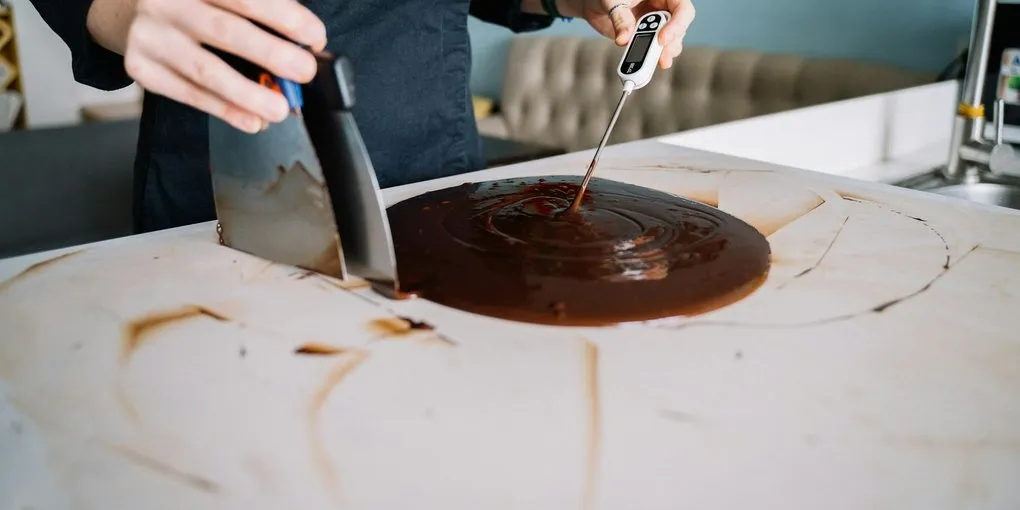
The best thermometer for tempering chocolate is a fast-reading probe thermometer accurate to at least 1°F. The Thermapen ONE or equivalent instant-read probe thermometers are the standard recommendation. Infrared thermometers read surface temperature only and are not accurate enough for tempering — they can read several degrees different from actual chocolate mass temperature, which is enough to fail the temper.
Why Accuracy Matters This Much
The working temperature range for dark chocolate is 85.5 to 87°F (29.7 to 30.6°C). That is a 1.5°F window. Exceeding 90°F (32.2°C) breaks the temper completely. Under 85°F, the chocolate is under-tempered and will set soft without proper Form V crystallization.
In a window this narrow, a thermometer that reads 2 to 3°F off is not a precision instrument — it is a coin flip. If your thermometer reads 87°F but the actual mass is 89.5°F, you are approaching the edge of the danger zone with no warning. If it reads 87°F when actual is 84°F, you have under-tempered chocolate.
Chocolate tempering tolerates no meaningful imprecision in temperature measurement. This is the one piece of equipment where buying cheap is the most expensive mistake you can make in terms of failed batches.
Why Infrared Thermometers Do Not Work
Infrared thermometers measure surface temperature by reading emitted infrared radiation from the top of the chocolate mass. The problem is that chocolate has a steep temperature gradient in a bowl — the surface exposed to air is cooler than the interior mass, especially in a partially stirred batch. An infrared reading of the surface can differ from the interior by 3 to 5°F or more.
Additionally, infrared accuracy depends on the emissivity setting matching the material being measured. Chocolate’s emissivity is not a standard factory preset. Even if you set emissivity correctly, the surface-versus-interior gradient problem remains.
Infrared thermometers are fine for checking oven temperatures, stovetop pans, or other applications where surface temperature approximates interior temperature. For tempering chocolate in a bowl, where the measurement you need is the mass temperature, a probe is required.
What to Look for in a Chocolate Thermometer
Speed: Response time of 2 to 3 seconds or less. Tempering is an active process where temperature changes continuously as you stir. A 10-second thermometer gives you historical data; a 2-second thermometer gives you current data.
Range: Needs to cover 70°F to 130°F (21°C to 55°C) comfortably. Dark chocolate tempering spans 85°F to 122°F; milk runs from about 80°F to 122°F; full melt-out goes to 120 to 122°F.
Probe length: At least 3 inches to reach into the chocolate mass without the handle contacting the warm chocolate surface. Shorter probes give surface-biased readings.
Waterproof (IP67 or better): Chocolate cleaning involves water. A thermometer that fails when splashed or submerged needs replacing constantly.
Display hold: The ability to freeze the reading after removing the probe from chocolate lets you check the number without rushing.
Recommended Options
Thermapen ONE Digital Thermometer
The Thermapen ONE reads in approximately 1 second and is accurate to ±0.5°F. It is waterproof to IP67, has a rotating display, and has a proven track record in professional kitchen environments. It is the most commonly recommended thermometer by chocolate-making resources. The cost is approximately $100, which is the right investment relative to the cost of failed batches.
ThermoPop 2 Digital Thermometer
The ThermoPop 2 is a step down from the Thermapen ONE in response time (approximately 3 seconds versus 1 second) but shares the same accuracy specification of ±0.5°F. At approximately $35, it is a reasonable option if the Thermapen ONE is outside budget. The slightly slower response time is workable for tempering.
Candy thermometers with a probe and dial display can work for tempering, but their typical accuracy of ±2°F is marginal given the narrow working range. If you use a candy thermometer, calibrate it in ice water (should read 32°F) before each tempering session and apply a correction factor.
Using a Thermometer for Tempering: Protocol
The probe should be fully immersed in the chocolate mass, not just touching the surface. When checking temperature, stir the chocolate first to even out any temperature gradients, then insert the probe, wait for the reading to stabilize (most good probes in 1 to 3 seconds), and read.
For the seed method: after adding solid tempered chocolate to the 120°F melt and stirring, check temperature every 2 to 3 minutes. You are looking for the combined mass to reach 86 to 87°F with no solid pieces remaining. Check in three different locations in the bowl and average the readings if they vary.
For tabling: check the tabled chocolate’s temperature on the marble before recombining. You want it at 26 to 27°C (78.8 to 80.6°F) before adding back to the warm portion.
Calibration
A thermometer that reads accurately out of the box may drift over time, especially after impacts. Check calibration by immersing the probe in an ice water slurry (50% ice, 50% water, well stirred) — a correctly calibrated probe reads 32°F (0°C). If it reads 31°F or 33°F, that offset applies to all readings and should be accounted for in your tempering targets.
The Thermapen ONE has a recalibration feature in its settings. Budget probes usually do not. If your budget probe is consistently reading 2°F high, adjust your targets accordingly — work at 85°F nominal when the actual target is 87°F.
The Thermometer in Context
The thermometer works in concert with everything else in the tempering process. For the complete tempering protocol using the seed method, see our how to temper chocolate guide. For understanding what happens at the crystal level when temperature goes wrong, see our cocoa butter chemistry and polymorphism article. For troubleshooting when temper fails despite using the right temperatures, see chocolate won’t temper.
Frequently Asked Questions
- Can I use an infrared thermometer to temper chocolate?
- No. Infrared thermometers measure surface temperature only, not the interior mass temperature. Chocolate in a bowl has a temperature gradient of 3–5°F between the surface and interior, which is larger than the entire working range for tempering (1.5°F for dark chocolate). A probe thermometer immersed in the chocolate mass is required.
- What accuracy do I need in a chocolate thermometer?
- You need a thermometer accurate to ±1°F or better. The working range for dark chocolate tempering is 85.5–87°F — a 1.5°F window. A thermometer accurate to ±0.5°F (like the Thermapen ONE or ThermoPop 2) gives you enough margin. A typical candy thermometer at ±2°F is marginal and should be calibrated before use.
- Is the Thermapen worth the cost for chocolate making?
- Yes. At approximately $100, the Thermapen ONE reads in 1 second, is accurate to ±0.5°F, and is waterproof to IP67. Given that a failed temper wastes 18–30 hours of melanger time and an entire batch of chocolate, the thermometer pays for itself in the first avoided failure. The ThermoPop 2 at approximately $35 is also adequate at slightly slower response.
- How do I calibrate a chocolate thermometer?
- Immerse the probe in an ice water slurry (50% ice, 50% water, well stirred) and note the reading. It should be 32°F (0°C). If it reads high or low, apply that offset to your tempering targets. The Thermapen ONE has a built-in recalibration feature. Budget probes usually require manually adjusting your target temperatures.
- What temperature range do I need my thermometer to cover?
- Chocolate tempering spans from the full melt-out at 120°F (48.9°C) down to the working temperature of 85.5–87°F for dark chocolate. A range of 70°F to 130°F covers all chocolate types including the 120–122°F melt-out for milk and white. Any good instant-read probe thermometer covers this range.
- Can I use a candy thermometer for tempering?
- Candy thermometers can work but with limitations. Their typical accuracy of ±2°F is marginal given the narrow tempering window. Always calibrate in ice water before use and apply any offset. A dedicated instant-read probe like the ThermoPop 2 produces more reliable results for the same or less money and is a better investment.